In 2022, we published 2,000 french and 2000 german copies of the first edition of our book “How to defend yourself during a police interrogation.” Since then, the content of our practical guide has continued to spread, taking many forms, such as a workshops we conduct, an “interrogation” supplement for the role-playing game Blade in the Dark and translations into English, and Spanish. The book has now also been reissued in French by Éditions du Commun under the title “A Short Guide to Self-Defense During Interrogations,” as well as an audiobook version, a radio spot, a self-print brochure version on infokiosques.net, and posters illustrating the “broken record” strategy.
In short, we’ve put a lot of effort to share our self-defense advice as widely as possible so that anarchists and other rebels can protect themselves against repression. And it’s not over yet, since translations into Arabic, Italian, and Danish are underway, and our door is always open to anyone who wants to help us to diffuse it or to reach other formats and linguistic-geographic areas.
During this adventure, we’ve gathered three unusual anecdotes we wanted to share publicly —taking this opportunity to remind you once again: protect yourselves from the police; read our book.
1 – The cops
In autumn 2024, during the occupation of the University of Neuchâtel (Switzerland) in support of Palestine, people became suspicious of the strange behavior of one individual present. When confronted, the man admitted to being a police officer, undercover.
Several people at the scene then recognize the person in question. A few weeks earlier, he had gone to the local anarchist library to borrow a book. Not just any book, but our book “How to protect yourseld during a police interrogation”.
When the police officer, still undercover, came to return the book, he reportedly said he found it “interesting, but not really useful and too long.” We can well imagine that, from a police officer’s perspective, it is not really useful to learn how to defend oneself against the police manipulations used during interrogations.
So who knows, maybe our next book will be about attempts by the police to infiltrate our social movements. We promise to keep it as short as possible. We know that police officers don’t like to read.
2 – The Neo-Nazi
March 2026 in France. Intelligence agencies discover that several neo-Nazis are planning to assassinate another neo-Nazi. The information is passed on to the police, who rush to intervene. “Too bad,” some might say, while others will count the instances where the police failed to take seriously or simply ignored alerts regarding plans for attacks or murders targeting people of color or queer individuals.
In any case, what interests us in this story is what the police found during a search of one of the would-be murderers’ apartments: a manual on how to behave when dealing with the police, particularly during an interrogation1.
That far-right extremists read our book is, unfortunately, nothing new. The PDF of the book was already archived under the “resources” section of a far-right website a week after we published it online. We hope they choke on all the passages that highlight anarchist, decolonial, and queer-feminist perspectives.
Depending on how the investigation unfolds, we’ll see whether reading the book was useful to them or not. In any case, if they don’t end up in prison, they might get murdered by their own comrades. It’s well known that those who sow a macho culture of ultraviolence reap knife wounds in the back.
3 – The Elephant
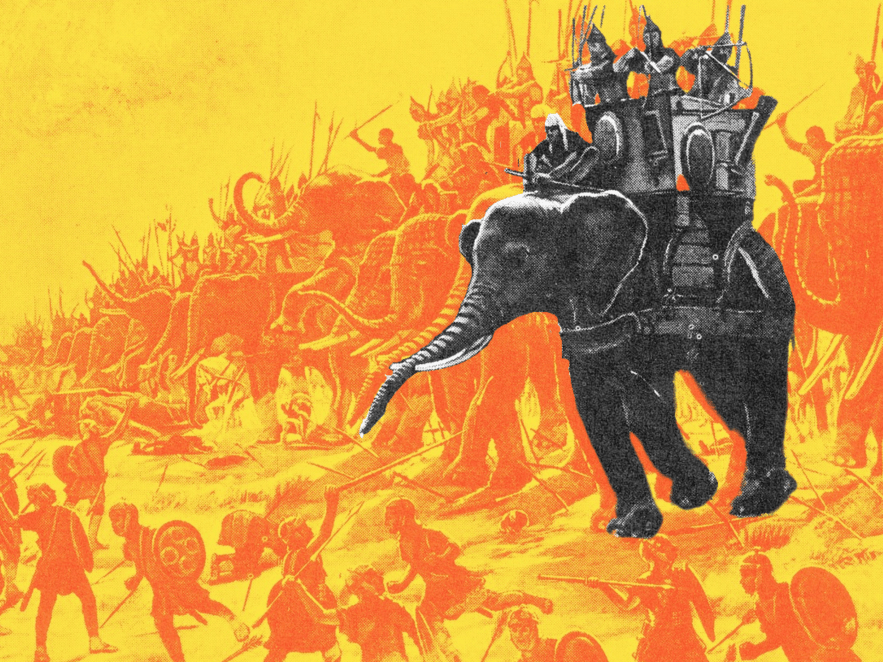
One could define war as the moment when kings, emperors, governments, and other powerful figures send the poor to slaughter each other. But that would boverlook the enormous number of non-human animals that are forcibly conscripted by humans. Notably, war elephants. These animals—which, believe it or not, are non-war elephants before their capture—are trained in a way that will surely remind you of certain interrogation strategies described in our book.
Every possible means offered by the conditions of captivity will be used to mentally break the elephant. Disruption of sleep and food, loss of the ability to make daily decisions, physical and psychological violence, uncertainty about its future and the duration of this treatment, social isolation, and severing of ties with its family. Once the elephant is deemed completely broken, the trainer—known as the mahout—appears. The mahout brings with him a significant improvement in treatment, thereby creating an empathetic bond that gradually allows him to gain control over the captive elephant and lead it to submit to the trainer’s will.
The same approach, then, as the one used by the police in their “Life Preserver” strategy. In this strategy, everything is set up—through the conditions of detention—to weaken and break down the imprisoned individual as much as possible before their interrogation. The same arsenal of tools offered by detention, adapted for humans. Then comes the cop, bringing a glass of water with a smile, kindly offering to let them make a phone call to the outside world, creating an emotional hold over the detainee, making them feel indebted and thus lowering their defenses. The “Life Preserver” strategy begins.
Within the Evasion Project, we advocate an anarchist analysis of the dynamics of oppression. We believe that these dynamics build upon one another and reinforce each other. Authority deployed against one social group will, in fact, strengthen the domination suffered by another social group. Hence the need to fight them on the same basis: a hatred of all forms of authority and domination, regardless of whom they target—human or otherwise.
1«Le guet-apens de néonazis ciblait un militant… d’extrême droite radicale», Mediapart, 22 mars 2026